
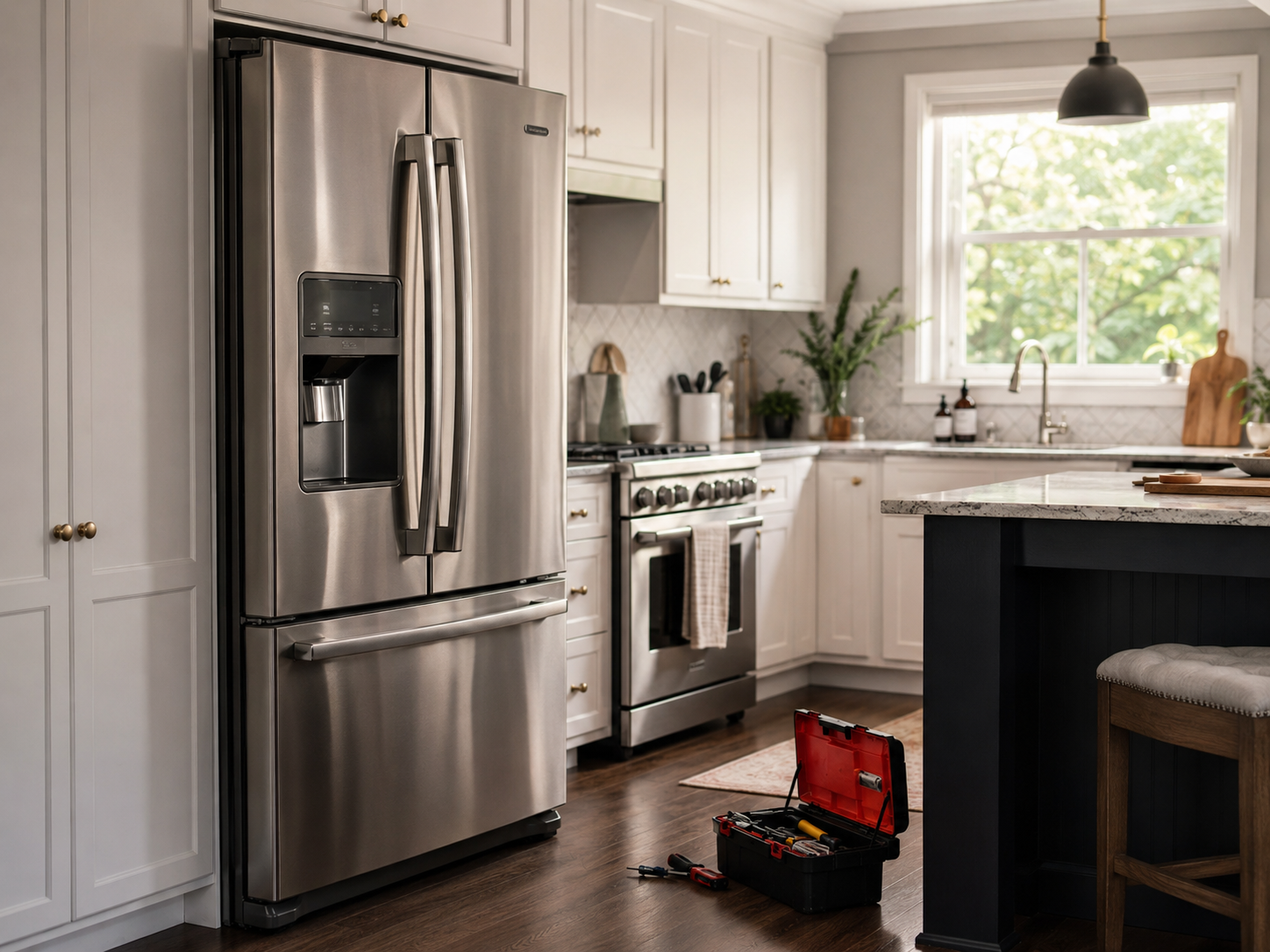
Freezer frost buildup comes down to one thing: moist room air getting in and freezing on the coldest surfaces. The fast answer is to check the door seal and how the door is closing first, then how full and how busy the freezer is, and only then suspect the defrost system. A thin, even frost inside an older manual-defrost chest freezer is normal. Thick frost in a frost-free freezer is not.
This guide explains why frost forms, how to read where it is sitting to find the cause, how to defrost properly without damaging anything, and when the frost is a symptom of a defrost failure that needs a technician in London, Kitchener or Cambridge.
Table of Contents

Why freezer frost buildup happens
Every time the door opens, warm air carrying water vapour rolls in. That vapour freezes on the first cold surface it touches. In a manual-defrost freezer it lands on the walls; in a frost-free unit it lands on the hidden evaporator coil, and a heater melts it away several times a day. Frost you can see in a frost-free freezer means either too much moisture is getting in, or the defrost system has stopped melting it.
Where the frost sits is your best clue. It tells you which kind of freezer frost buildup you are dealing with.
- Around the door opening or gasket — air is leaking past the seal.
- On the back wall or the panel covering the coil — the defrost system is not keeping up or has failed.
- A sheet of ice on the freezer floor — the defrost drain is blocked and meltwater is refreezing.
- Fluffy, even frost on everything — humidity and habits: warm food, frequent opening, a door left ajar.
Start with the door seal and how the door closes
Most frost calls we get in London end at the door. Do the paper test: close a strip of paper in the door at several points around the gasket and pull. If it slides out with no drag anywhere, the seal is not gripping there.
The paper test is simple: close the door on a strip of paper and pull it out. Do that every 20 cm around the whole frame, top edge and hinge side included. Anywhere the paper slides out with no resistance is a gap. Small gaps from a gasket that has flattened can often be revived by warming the rubber gently with a hair dryer and pulling it back into shape, but a gasket that is torn, hardened or has come away from its channel needs replacing, and that is a modest part for most brands.
Clean the gasket with warm soapy water and dry it; grime and crumbs hold the door open by a hair, and a hair is all it takes. Look for splits, hard spots and corners that have pulled away. A torn or hardened gasket needs replacing.
Then look at the door itself. A bag of peas or an ice cube tray wedged against the door will hold it open a few millimetres all night. Check that the unit is level or tilted slightly back so the door swings shut on its own. On a chest freezer, make sure the lid closes square. A door that does not close cleanly is the most common freezer frost buildup cause we find.
Humidity, habits and overpacking
Southwestern Ontario summers are humid, and a basement freezer in Hyde Park works harder in July than in January. You cannot change the weather, but you can change how much of it gets inside.
Packing matters as much as humidity. A freezer that is crammed to the ceiling blocks the vents that circulate cold air, and one that is nearly empty warms up faster every time it is opened, so frost forms quicker in both cases. Aim for about three-quarters full, leave a hand-width of space in front of the vents at the back, and let cooked food cool on the counter before it goes in, because a warm casserole releases steam that becomes frost within hours.
- Let cooked food cool before it goes in. Steam is pure frost.
- Open the door less and decide what you want before you open it.
- Keep vents clear. Bags pressed against the air vents at the back block circulation, so the coil ices while the front stays warm.
- Keep the freezer about three-quarters full. Frozen food holds the cold; an empty freezer pulls in more warm air every time it opens.
Frost is not just cosmetic. A layer of ice on the coil insulates it, so the compressor runs longer to do the same job. Natural Resources Canada lists keeping seals tight and coils clear among the basics for keeping a fridge or freezer efficient. Freezer frost buildup costs you electricity long before it costs you a part.
When it is the defrost system
Frost-free freezers and fridge-freezers rely on three parts working together: a defrost heater under the evaporator coil, a defrost thermostat (or sensor) that tells the heater when the coil is cold enough to need melting, and a timer or control board that schedules the cycle. If any one of them fails, the coil turns into a block of ice over a week or two.
You can get a strong hint without tools. Unplug the freezer, leave the door open for a day so the coil clears completely, then plug it back in and watch over the next week. If a clean, even layer of frost returns on the back panel while the door seal is fine, the defrost cycle is not running and one of the three parts has failed. If instead the frost gathers around the door edges or on the food, the problem is air getting in rather than a defrost fault.
The signs are fairly distinctive. Frost builds on the back panel rather than the door. The freezer stays cold but the fridge section slowly warms, because the iced coil blocks the air that is supposed to flow up to it — the pattern we cover in our post on a fridge not cooling while the freezer works. That pattern is the signature of freezer frost buildup from a failed defrost system.
Diagnosing which of the three parts failed takes a multimeter: the heater and thermostat are checked for continuity, and the timer or board is checked for whether it is calling for defrost at all. A manual defrost buys a week or two, but the frost returns until the part is replaced.
From the van: when a customer says the freezer is fine but the fridge is warm, we pop the back panel of the freezer before anything else. More often than not the coil is one solid block of ice, and the whole fault is a defrost heater that quietly gave up a month ago.
Appliance Experts repairs freezers and refrigerators across London and Southwestern Ontario, 6 AM–9 PM, seven days a week — usually same day. The service call is free with the repair, and every job carries a 90-day parts and labour warranty.
How to defrost a freezer properly
Whether you are clearing manual-defrost frost or resetting a frost-free unit before a repair, the safe way is the slow way. Done properly, a full defrost resets the clock on freezer frost buildup and lets you see whether it comes back.
- Unplug the freezer or turn it off at the breaker. Do not work inside a freezer that is powered.
- Move the food to coolers with frozen jugs of water.
- Lay towels on the floor and, on an upright, put a tray on the bottom shelf to catch meltwater. Chest freezers usually have a drain plug near the base; open it over a pan.
- Leave the door open and let it melt. Bowls of hot water on the shelves speed it up.
- Never chip ice with a knife, screwdriver or ice pick. One slip through the coil ends the freezer.
- Skip the hair dryer. A wet cavity and a mains-powered appliance are a poor combination.
- Wipe it dry, plug it in and wait until it reaches -18°C before reloading, usually two to four hours.

When to call a pro
Call us if the frost is back within a couple of weeks of a full defrost, if it collects on the back panel rather than the door, if the fridge side is warming while the freezer is cold, or if there is an ice sheet on the freezer floor that keeps returning. Those are defrost heater, thermostat, control or drain faults, and they are worthwhile repairs on most units — typically $220 to $500 in Southwestern Ontario, with the $90–$140 diagnostic fee applied to the repair. Fast-returning freezer frost buildup after a proper defrost almost always means a part has failed.
A stand-alone chest or upright unit is covered under our freezer repair service, and we run dedicated freezer repair in Kitchener alongside London, Waterloo and Cambridge. A fridge-freezer with an iced coil falls under refrigerator repair. If it is frosting and not getting cold at all, read our guide to a freezer not freezing first.
Frequently asked questions
Why is my frost-free freezer building up frost?
A frost-free freezer should never show visible frost. If it does, either too much moist air is getting in through a poor door seal or a door left ajar, or the defrost heater, thermostat or control has failed and the coil is icing over. Frost around the door points to the seal; frost on the back panel points to the defrost system. Visible freezer frost buildup on a frost-free model is a symptom, not a normal condition.
Is it normal to have frost in a chest freezer?
A thin, even layer of frost on the walls of a manual-defrost chest freezer is normal and should be scraped or defrosted when it reaches about half a centimetre. Thick frost that returns quickly usually means the lid seal is leaking or the lid is not closing square.
How do I get rid of ice buildup in my freezer?
Unplug it, move the food to coolers, and let the ice melt with the door open, using bowls of hot water and towels to catch the meltwater. Never chip at ice with a knife or metal tool, and avoid hair dryers. Dry it out, plug it back in, and reload once it reaches -18°C.
Can a bad door seal cause frost in the freezer?
Yes, and it is the most common cause we find. A gasket that is dirty, torn or stiff lets warm, humid room air in continuously, and that moisture freezes as frost around the door and on nearby shelves. Try the paper test around the door; where the paper slides out easily, the seal is leaking.
The bottom line
Freezer frost buildup is moisture getting in faster than the freezer can deal with it. Check the door seal and closing habits first, cut the humidity you are adding with warm food and open doors, and keep the vents clear. If frost keeps coming back on the rear panel or the fridge side is warming, the defrost heater, thermostat or control has likely failed, and that is a straightforward repair. Defrost it safely in the meantime, and call Appliance Experts at (519) 900-3010 when you want it fixed for good.